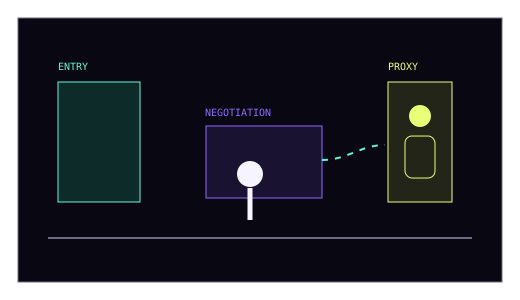
A lobby becomes a negotiation between bodily arrival and delegated arrival.
If AI can increasingly attend, negotiate and act for us, what makes physical presence worth choosing, and how should architecture respond?
THESIS
ARCHITECTURAL QUESTION
This project asks how delegated presence changes the value, design and social role of physical space. Rather than treating AI as a layer added to buildings, it treats proxy action as a pressure that reorganises thresholds, waiting, assembly, work, learning, care and hospitality.
SPATIAL IMAGINATION
A lobby becomes a negotiation between bodily arrival and delegated arrival.
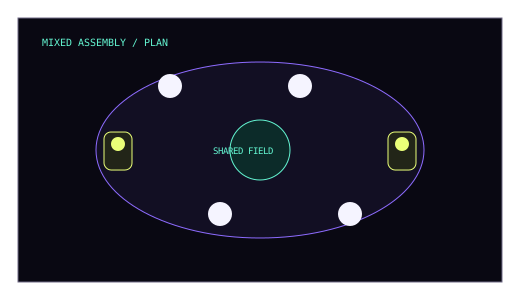
A classroom, studio or civic forum hosts present bodies alongside represented participants.
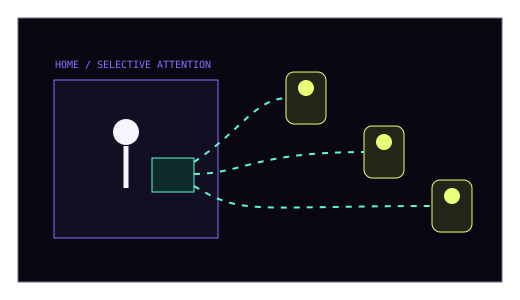
The home becomes a place from which a person sends delegated presence into outside systems.
ARCHITECTURAL CLAIMS
The research becomes architectural when it moves from etiquette alone to rooms, institutions, circulation, interfaces, thresholds and the embodied conditions of co-presence.
A proxy does not only change communication. It reorganises where people need to go, how long they stay, which encounters still require bodily attendance, and how institutions stage participation.
As machines absorb instrumental tasks, the value of architecture may shift from processing people efficiently toward making co-presence desirable, legible and humane.
Attendance is no longer binary. Buildings will host mixtures of direct presence, represented presence, remote observation, partial participation and strategic absence.
The Aalto lineage matters here as a value system: warmth, tactility, scale, light, social softness, retreat, and embodied comfort become criteria for evaluating architecture under proxy conditions.
AALTO AS VALUE LINEAGE
The Aalto reference anchors the project in warmth, tactility, scale, light, social softness, retreat and embodied comfort. As machines absorb instrumental activity, architecture may be judged less by how efficiently it processes people and more by whether it creates places people genuinely want to inhabit together.
TYPOLOGIES
Lobbies, service desks, waiting rooms and institutional entrances will increasingly mediate between present people and absent people acting through credentials, devices or agents.
Classrooms, studios, meeting rooms and civic forums will need new protocols for mixed participation: who is really present, who is represented, and how authority is spatially staged.
Homes may become the sites from which people dispatch proxies into work, care and administration, raising questions about privacy, friction, background space and selective attention.
The most resistant spaces to delegation may be those where reassurance, touch, witness and hospitality matter most. That resistance is architecturally important.
RELATED PROPOSITION
Robot circulation, proxy entrances, machine-readable permissions and human-priority zones are not only technical infrastructure. They can physically express which intentions a society chooses to preserve.
RESEARCH PROGRAM
Observe offices, waiting rooms, schools, homes, service environments and civic settings. Use interviews, film and behavioural mapping to understand what physical presence currently does socially and architecturally.
Trace where AI systems already speak, schedule, purchase, negotiate, filter and decide for people, then map which rooms, counters, queues, desks and encounters those actions displace or transform.
Design and test rooms, thresholds and institutional situations for mixed human and proxy participation. Work through plans, sections, interfaces, furniture, signage, scenarios and 1:1 fragments.
Compare prototypes through qualitative feedback, behavioural observation and architectural reading, then synthesise principles for humane architecture under conditions of delegated presence.
EXPECTED OUTPUTS
O01A conceptual framework for delegated presence as an architectural condition
O02A set of architectural typologies and scenarios for mixed human and proxy participation
O03Design principles for spaces of chosen presence, where being there still matters
O04A hybrid method combining architecture, interaction design, ethnography, filmmaking and spatial prototyping
OPEN QUESTIONS
Q01If agents can attend, negotiate and act on our behalf, what forms of space become more valuable precisely because they gather bodies rather than process transactions?
Q02How do delegated presence and active absence alter thresholds, waiting, assembly, hospitality, work, learning and care?
Q03What architectural qualities support chosen presence: spaces people still want to inhabit because being there offers embodied, social and emotional value that delegation cannot replace?
Q04How should architecture reveal, stage or constrain the participation of absent people acting through autonomous proxies?
PROPOSITION
The dissertation's wager is that the rise of proxies does not make architecture less important. It makes the spatial, social and sensory value of being somewhere together newly visible.